
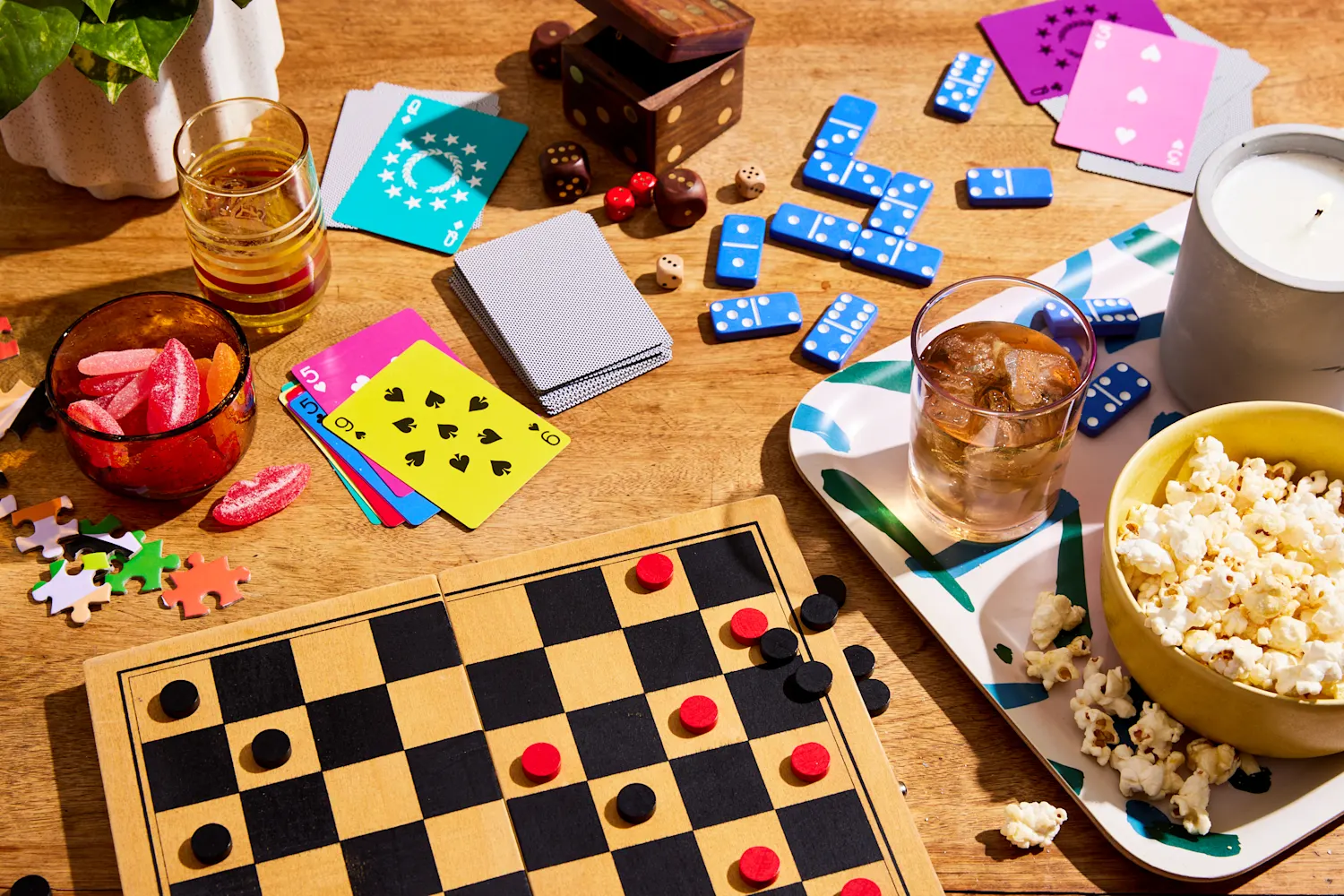
When summer is around the corner, the first thing that comes to mind for most people is the beach, playing outside, soaking up every bit of that sunshine. And honestly? I get it. But for me — personally, unashamedly — nothing beats chilling inside with cool air, a cold glass of fruit punch, and a table full of games with friends or family.
Maybe a good walk in the evening when the air has finally decided to be decent instead of delivering desert-oven energy. But otherwise? Give me the indoors, give me the snacks, give me the games.
Board and card games are my favourites — not just because they’re perfect for inside days, but because there’s so much more going on than people realise. Light strategy card games are easy to pack for travel, great for passing time, and genuinely good for your brain. We’re talking motor skills, strategy and pattern recognition, reading people, adapting on the fly. These games are quietly building skills every round — they just happen to be wildly fun at the same time.
So here are three games I think absolutely deserve a spot on your game night table. Each one plays differently, suits different moods, and brings its own kind of chaos to the table. Let’s get into it.
1. BIBLIOS

If you’ve ever wanted a game that feels like a light-hearted card game on the surface but slowly reveals itself to be a beautifully tense little strategy puzzle — Biblios is your game.
The premise is simple: you’re a medieval abbot competing to build the most impressive monastery library. To do that, you need to collect the most sets of manuscript cards across five colour categories. But the way you collect them? That’s where things get interesting.
How It Works
Biblios runs in two phases, and both of them matter:
Phase One — The Gift Phase: You draw cards one at a time and make fast decisions. Do you keep this card for yourself? Send it to the auction pile? Or lay it down for your opponents to grab? Every card you touch, you’re giving something away. It’s fast, it’s quiet, and it’s full of tiny moments where you give yourself away without meaning to.
Phase Two — The Auction: Remember that face-down pile you were all building during Phase One? Now it goes up for bid — and here’s the twist. The currency you’re bidding with is money cards you also collected during Phase One. So your bidding power depends entirely on how smart you played earlier.
There’s one more layer: Church Cards. These let you raise or lower the victory point value of any colour category during the game. A category worth 3 points can suddenly be worth 1 — or 5. Strategies collapse. New ones form. The game keeps moving.
Why I Love It
Biblios is described as a ‘light filler game’ but don’t let that fool you. The tension is real. Every decision you make in Phase One shapes Phase Two in ways you can’t fully predict. You’re managing what you keep, what you give away, what you hold back — all while reading what everyone else might be collecting. It’s got hidden information, auction bluffing, and value manipulation packed into a tiny box.
It’s also genuinely quick to learn. Ten minutes to explain, then you’re playing. And it plays fast enough that you’ll want to go again immediately.
Players: 2–4
Age: 10+
Play Time: 30 minutes
Best For: Couples, small groups, strategy fans who don’t want a 3-hour commitment
2. HONGA

Honga is a prehistoric strategy game — yes, prehistoric — and I need you to hear me out before you move on, because this one is genuinely brilliant and also contains a saber-toothed tiger who will absolutely steal your stuff if you ignore him.
You’re a clan member competing to become the new clan leader by racking up the most victory points. You do this by gathering resources, trading at the market, and climbing a mountain. Standard strategy game stuff. Except there’s Honga.
Meet Honga
Honga is the saber-toothed tiger who lives in the centre of the board and demands your attention every single round. Here’s the rule: on your turn, you must assign at least one of your action discs to Honga — essentially offering up one of your actions to keep him happy. If you don’t? He moves to your player board and steals your food and mammoths. And that is not a good time.
This mechanic sounds simple, but it creates this constant, wonderful tension where you’re always sacrificing one action to protect yourself from Honga while still trying to outmanoeuvre everyone else. Every round is a balancing act between what you want to do and what you have to do.
How You Score
Players use action discs on cards to fish, gather berries and mushrooms, trade resources at the market, and climb the mountain for points. The player who best manages their resources — while staying on Honga’s good side — wins.
The components alone are worth mentioning: a proper central board, individual player boards, a Honga figure that physically moves around the table, and action discs for everyone. It’s a well-produced game that looks great on the table.
Why It Works for Game Night
Honga hits the perfect middle ground: it’s strategic enough to keep adults engaged, but the prehistoric theme, the tiger mechanic, and the easy-to-grasp rules make it genuinely fun for families too. It plays up to five, which means it scales well whether you’re a small group or a slightly chaotic family situation. And there’s something deeply satisfying about telling someone across the table ‘Honga is very hungry tonight’ and watching them panic.
Players: 2–5
Age: 8+
Play Time: 45–60 minutes
Best For: Families, mixed-age groups, anyone who wants strategy with a side of silliness
3. ZEUS ON THE LOOSE

If the first two games have any patience requirements at all, Zeus on the Loose is here to throw patience out the window and replace it with pure, fast-paced chaos. This is the game you pull out when the energy in the room needs to go up immediately.
The concept: everyone is building a pile of cards called Mount Olympus. The goal is to be holding the Zeus figurine when the total value of the pile reaches 100 or more. The first player to collect all four letters — Z, E, U, S — wins the whole game.
The Mechanics Are Deceptively Simple
Number cards (1–10) get played onto the pile, adding to the total. Simple maths. Except there are rules layered on top that keep everyone scrambling:
- Play a card that makes the total land on a multiple of 10? You steal the Zeus figurine.
- Play a card that matches the number on top of the discard pile? Also steal Zeus.
- Greek God Cards let you break the rules entirely — Apollo can round to the nearest 10, Poseidon can flip the total, Hera can skip the next player, and so on.
The Zeus figurine physically passes around the table throughout the game. Whoever is holding it when the pile hits 100 wins that round and earns one letter toward ZEUS.
Why This Is the Game Night Wildcard
Zeus on the Loose is loud and fast and the kind of game where everyone is paying attention even when it’s not their turn, because someone might be about to steal Zeus from you. It takes about five minutes to explain, works for ages 8 and up, plays in 20–30 minutes, and is genuinely excellent for mixed groups where some people are serious gamers and some people just want to have fun without learning a rulebook.
It also doubles as sneakily educational — you’re doing mental maths the whole time, adding to 100, spotting multiples of 10, tracking the pile total. Kids are basically studying without realising it. Adults are too, honestly.
Players: 2–5
Age: 8+
Play Time: 20–30 minutes
Best For: Large groups, families with kids, anyone who wants no-prep instant fun
Final Thoughts
Three games, three completely different experiences — and all of them work for a game night that actually delivers. Biblios for when you want something thinky and tense. Honga for when you want a strategy that everyone at the table can actually follow. Zeus on the Loose for when you need the whole room laughing within five minutes.
Whether it’s summer and you’re hiding from the heat, or it’s one of those evenings where the air outside has finally remembered how to behave — these games will do the job. Pull out the fruit punch, clear the table, and let the chaos begin.
Have you played any of these? Let me know in the comments which one you’re adding to your collection first — I want to know if Honga causes as much drama at your table as it does at mine.
Want more of such cool recommendations click on the links below for more ideas!!
Leave a Reply